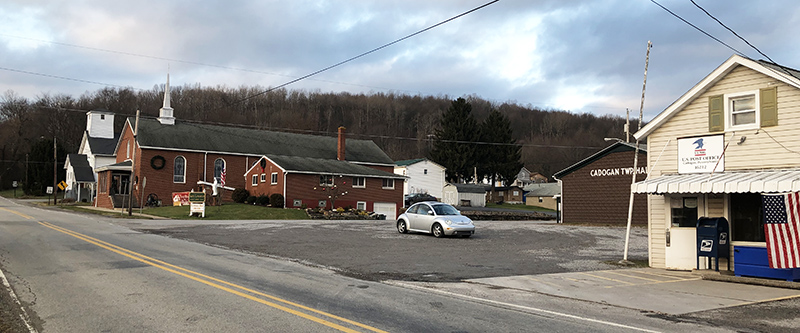
Until about 1953, Cadogan had a movie theater that sat on this vacant lot next to the Cadogan Township Building (then a union hall).
Jack Dunmire likes to discuss past history of Armstrong County and its residents as he hosts the weekly Family-Life TV cable show, “Talk of the Town.” Last Tuesday night, a caller brought up the existence of a movie theater in Cadogan.
“Yes, there was a movie theater in Cadogan,” said caller Tom Round whose family had deep roots in the township.
In an era prior to the mid-1950’s, Cadogan was a mining town, owned by a British company, Round said.
“The Irish would not work for the British. My grandfather was a Welshman. He was hired to be a straw-boss in the mines because the Irish, Italian, and Hungarian miners would work for my grandfather, the Welshman, but they wouldn’t work for the Brits. So that’s how he became a straw-boss. There was sort of a caste system even back then between the workers and the supervisors.
“The entire town was owned by the mining company. They built all the houses for the workers. Down where the company store used to be on the south side going toward Freeport, the houses along the right hand side of the roadway – we called that ‘Boss’ Row’ because all the bosses in the mines, those houses were built for them. They could come out on their front porch and look down over the hill and see the mining operation.
“My grandfather’s house wasn’t down on Boss’ Row, but it was back on Oak Avenue. When you would come into Cadogan, up the hill from Skinnall, you would turn left and go back in that part of the town. So my grandfather’s house was built on the hillside overlooking the mining operation.”
Being born in 1947, Round’s recollection of the movie theater was limited, but he still remembered going to a movie about mid-1950.
“My brother was born in 1950. I can recall my mother and father taking me and my brother over to the theater. My brother was a baby-in-arms, and they were hoping like heck that he would be quiet during the film so we wouldn’t get thrown out.
“We lived across the street from the theater. My mother and father owned a bungalow that was situated behind the Catholic Church, which is now a paved parking lot.
“Between the church and what is now the post office, in what is now a limestone parking lot today which is next to the township building, which originally was the union hall for the miner’s union, that’s where the theater sat.”
Round said he believed the theater was owned by the mining company.
“I know it was in operation until about 1953. My uncle, Harold Round, was the projectionist. I remember him telling me stories about the place. He said one of the hardest things he had to do was to get the sound to synchronize with the film. He was very proud that it was one of the first movie theaters in Armstrong County that had ‘talkies’. There was a disc record. He would start the film and then he would bounce the arm of the record player across the grooves until you lined up the lips moving with the sound. Sometimes it took a minute or two. He claims he got better at it as time went on.
“I remember there was a marquee above this little porch roof that stuck out over the entrance off of First Avenue. They would put the name of the film that was being played up there. It was like a yellow backboard. They would put the letters up there. But I don’t recall a name of any type. Ford City had the Roxy Theater, but I don’t recall any name being up there on that marquee. I believe it was sponsored and owned by the mining company.
“It had a small lobby. It had a nice stuff couch and furniture. There was a desk-type table, which I have in my house here. My grandmother bought the furniture that was in the lobby. We loaded it on Uncle Al’s pickup truck and carted it over into the living room.”
“It closed down about the time the mining company was selling off all of the houses in town. When they quit supporting the theater, it couldn’t run as a private enterprise, so it was closed down.
“A man came in and bought the building. All I can remember is his name was Jim. We called it Jim’s Store. He converted it into a grocery store. The entrance was out toward the highway. I remember going in there and shopping for groceries with my mother. It was in operation for two or three years; then, there was an electrical fire. It burned completely to the ground. That was about 1956. They never rebuilt it. They bulldozed what was left of it, they hauled in red-dog and put it down first. Then later on they put limestone on it.”
Anyone with any additional information or photos is welcome to submit them to the Kittanning Paper for a follow-up on this article at a future date.