
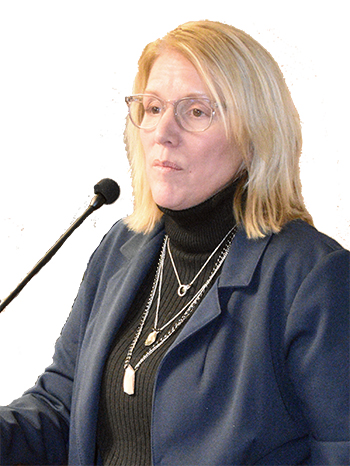
Dr. Paula Berry said teachers are preparing students in Kindergarten and grades 1 and 2 - long before they take the assessment in Grade 3.
Building principals for West Hills Primary and Intermediate schools addressed the Armstrong School District board of directors last month to discuss how well their students were doing as compared to state norms.
“I work really close with Mr. (Jarrod) Toy and Dr. (Charles) Krienbucher,” West Hills Primary Principal Paula Berry stated. “Because we are a campus, we look at our students (collectively) and discuss what we need to shift or change.”
Berry’s building houses Kindergarten through Grade 3. She said the only statistics available from state assessment tests are for Grade 3.
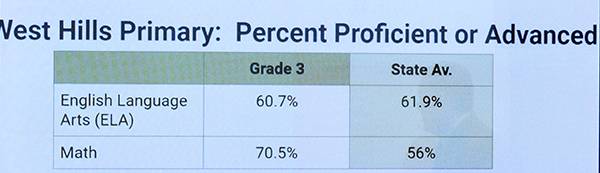
“In grades K-2, we gather a lot of different data to make sure we are heading in the right direction for our PSSAs,” she said. “Our ELA (English/Language/Arts) scores are 60.7%. We are right there with the state, always looking to improve, but comparable to the state. In Math, 70.5% of our students were proficient or advanced – well above the state average of 56%.”
Berry said the implementation of a Multi-Tiered Systems of Support (MTSS) along with schedule changes is working well.
“We have co-teaching now in grades first through third so that’s going to meet the needs of our learning support students, making sure they get the general education and the interventions that they need so they get the core and more.”
Berry said there are approximately 650 students in her building.
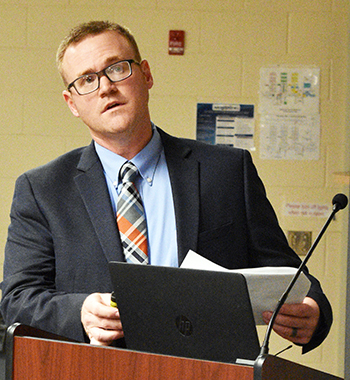
Jarrod Toy, Assistant Principal for both West Hills Primary and Intermediate schools, concentrated his discussion on Grades 4-6.
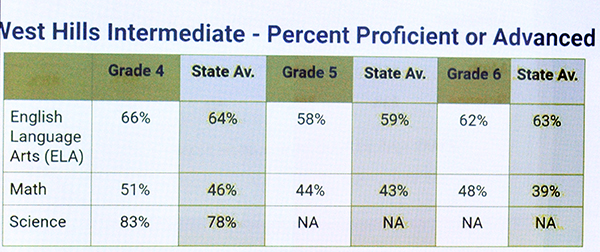
West Hills Intermediate students excelled at mathematics in all levels, according to Assistant Principal Jarrod Toy.
“In Grade 4 for English Language Arts, we were at 66% just slightly above state average. Grade 5 for English Language Arts, we were 58% just at state average. And Grade 6, we were at 62%, also around state average. Our Math was above in all grade levels. Grade 4 was 51%; Grade 5, 44% and Grade 6 was 48%. These are all areas we are definitely working on to increase the growth. In Science, our 4th grade was 83% proficient and advanced, which the state average is 78%,” Toy announced.
He said that Grade 4 had a slight decline.
“That’s really going to be our big focus this year,” he added.
In addition to meeting with parents, the teachers and department heads are meeting among themselves to see what can be done to improve performance.
“We’re meeting with individuals all teachers, the faculty here, looking at their data - individual data and classrooms - and what can we do to support them. Another thing we’re doing is grade/department meetings. This gives teachers the opportunities to collaborate and work together, discuss their expertise in math, reading and share ideas. We are also concentrating on standards-based instruction. We want to make sure teachers know what their grade-level standards are, and make sure they’re teaching them at an appropriate rigor so the students are prepared for our state assessments. The classroom teachers they are also making focus plans where they get to meet with us and talk about their performance on their benchmark assessments that they take throughout the year,” he said.
The District has implemented new mathematics software district-wide.
“We’re trying to build ‘number-sense’, math by incorporating daily activities the teachers do with students to help them create that number sense. We’re also focusing on open-ended tasks because, once again, that’s such a big part of the state assessment. It’s almost a fourth of weight for the assessment,” Toy said.
On Tuesday, January 7, the Kittanning Paper will examine reports from Elderton and Lenape elementary schools.