95-Year-Old Veteran Honored at Ford City VFW
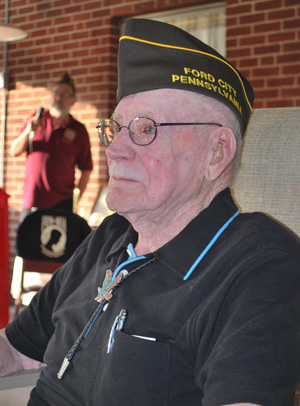
95-year-old Benjamin Rupp was honored last month by the Ford City VFW Post 4843 as the oldest living member of the Post. Rupp served in World War II.
by David Croyle
The Ford City VFW Post 4843 in Pattonville honored the oldest member of their Post - a World War II veteran - in September.
Post Commander Daryl Ray led the ceremony honoring 95-year-old Benjamin Rupp.
“We have made Benjamin the Honorary Post Commander for today of Post 4843, Ford City, Pennsylvania, for September 18, 2015,” Ray announced to a gathering of more than 50 people on the Post patio.
Following the war, Rupp was awarded the Bronze Star, the American Campaign, European African Middle-eastern, World War II Victory, and Good Conduct Medals and the Combat Infantry Badge, Expert Badge in the Carbon Rifle, Sharp Shooter Badge and Marksman Badge in Machine Gun and Pistol.
He survived in the Battle of the Bulge, a major German offensive campaign toward the end of World War II in Europe. The surprise attack caught the Allied forces completely off guard. United States forces bore the brunt of the attack and incurred their highest casualties for any operation during the war.
“We went in in Normandy Beach and went clear through the whole war within 20 miles of Russia when peace was declared,” Rupp said.
He related one of his most memorable moments of his war-time experiences that occurred where he was sleeping.
“It was a shell - 10 to 12 inches big around, four feet long, and you could hear it coming for miles and miles. It come down and hit within 18 inches of me and didn’t go off. If it would have, I wouldn’t have been here tonight. If it would have, they would have never found my dog tags. I didn’t know nothing about it until the next morning. I got up and went outside and the engineer had it all taped off with engineer’s tape. You could have run a Mack truck into it and never seen it.”
Rupp remembered meeting U.S. Army General George S. Patton, Jr., who commanded the Seventh United States Army in the Mediterranean and European Theaters of World War II.
“I was as close to Patton as you and I are here talking on the front lines. It was four o’clock in the evening and we were in a little town 30 miles from Russia, and he come up walking the alley and right by the billet where we were staying. I was out checking the area and he come up and talked to me just like you and I are talking here. Then he said he had to go, and he left, and I went back into the building and stayed the next night.”
Rupp brought back a mussel loader/pistol with a bayonet at the end of it. He said he retrieved it from an abandoned garage at some point during his tour of duty but couldn’t remember the exact place.
“Back then, you didn’t know where every little nick and corner was. I took it into Kittanning one time to an (antique dealer) and he said he saw one like it. It was a thousand dollars, and this one I had was worth a lot more.”
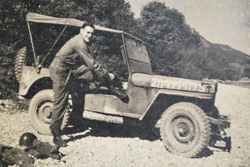
This photo, taken with a German camera, shows him pulling up to the water’s edge to wash his vehicle. Rupp carries the photo in his wallet and still remembers exactly what happened that day. “There was a lady washing some clothes or something. I didn’t smoke cigarettes or nothing and we would get a carton of cigarettes a month. I was there and she was over in the run (stream) washing some clothes out, and a I gave her a cake of soap. And I think she would have come to America with me if I would have said ‘Come!’ “ Rupp said.
During his tour of duty, most of his assignments centered around transportation since he was mechanically inclined.
“I drove Jeep from the time we went overseas till the war was over. I hauled the company commander. He said I was the best damn Jeep driver in the ETO (European Theater of Operations). When you were in the war, and you got tied up, you fixed whatever you had.”
After coming home from the war in 1945, he worked for a short time at the Schenley distillery plant. When his brother brought a truck, he began to haul coal from Brookville to Tidal. His next employment came as a car mechanic for McCune Ford (now known as Noel Ford) for seven years before founding his own vehicle repair shop and doing odd jobs.
He summed up his life in one short sentence.
“Where there is a will, there is a way!” he said with a twinkle in his eye.
He married Helen White after his tour of duty. White also participated in the war effort by working in Millerstown building hangars for the planes that carried the bombs. They had their son David in 1949, and daughter Annette in 1959. Helen passed away in July 2010. He continues to live on the original family property in Boggs Township.
 Local News | David Croyle October 1, 2015